
Nike loses S&P 100 spot after 18 yrs; stock plunges 80% from peak, wipes out $230 bn - What went wrong?
ADVERTISEMENT
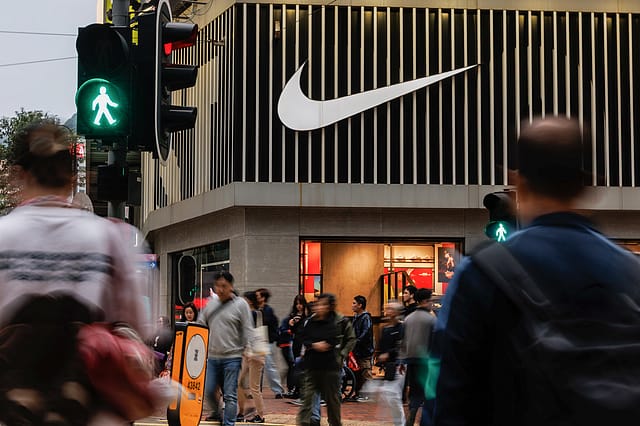
Nike, the world's largest sportswear and athletic apparel company by market capitalisation, is set to lose its place in the S&P 100 after nearly 18 years, as a steep decline in its share price has eroded its market value amid struggles to revive growth and regain market share.
S&P Dow Jones Indices will remove Nike from the index effective September 21 as part of its quarterly rebalancing. Honeywell Aerospace, Simon Property Group and Colgate-Palmolive will also be dropped from the S&P 100.
Meanwhile, Dell Technologies, Palo Alto Networks, Arista Networks and SanDisk will be elevated from the S&P 500 to fill the four vacancies. The reshuffle will further increase the technology sector's representation in the index.
Stock down 80% from its 2021 peak
With a market capitalisation of around $57 billion, Nike shares have fallen nearly 80% from their all-time high and are now trading at their lowest level in about 12 years. The stock ranks among the S&P 500's weakest performers over the past decade.
On Friday, September 4, 2026, Nike shares closed at $38.40, roughly 50% below their 52-week high of $76.97, marking their lowest level in about 12 years. The Dow Jones heavyweight has fallen nearly 80% from its record high of $179.10, reached on November 5, 2021, wiping out roughly $230 billion in market capitalisation.
Nike will continue to remain part of the broader S&P 500. However, the sharp decline in its market value has pushed the company out of the S&P 100, which tracks 100 of the largest and most established US companies.
The stock is down 39.3% year-to-date and 48.2% over the past year, reflecting growing concerns over Nike's weakening growth profile and competitive position.
Nike remains profitable and one of the world's largest sportswear companies, but several parts of its business have come under pressure. Revenue has declined from $51.2 billion in fiscal 2023 to $46.4 billion in fiscal 2026, while operating margin has narrowed from 15.6% in fiscal 2021 to 8.2% in fiscal 2026.
The company has also struggled to reignite growth in its footwear business, while its direct-to-consumer operations have weakened. Greater China remains a significant drag, even as rivals such as On, Hoka and New Balance have gained traction, particularly in performance footwear.
For the fourth quarter ended May 31, 2026, Nike's revenue fell 1% year-on-year to $11 billion, or 4% on a currency-neutral basis. Wholesale revenue increased 4% to $6.6 billion, while Nike Direct revenue declined 7% to $4.1 billion.
For the full fiscal year, revenue was $46.4 billion, broadly flat on a reported basis and down 2% on a currency-neutral basis.
Looking ahead, management expects fiscal 2027 first-quarter revenue to decline by low- to mid-single digits. Excluding tariff-related benefits, earnings per share are expected to remain broadly flat over the following three quarters.
CEO Elliott Hill has said Nike is focused on rebuilding the foundation of the business through product innovation, brand strength, marketplace execution and cost efficiency. The company returned about $2.5 billion to shareholders in fiscal 2026, including $2.4 billion in dividends and $123 million in share buybacks.
(DISCLAIMER: The views and opinions expressed by investment experts on fortuneindia.com are either their own or of their organisations, but not necessarily that of fortuneindia.com and its editorial team. Readers are advised to consult certified experts before taking investment decisions.)